
Every January, budgets get signed off, targets are set, and marketers are told the same thing: “Spend wisely. Deliver growth.”
But here’s the uncomfortable truth: most brands don’t fail because they didn’t spend enough. They fail because they didn’t plan to win.
Planning is more than allocating budget lines and booking channels. Planning is deciding where the brand will compete, how it will matter to people, and how the team will defend their choices in the boardroom.
As we head toward 2026, the context for CMOs is more complex than ever. Inflationary pressure, consumer fragmentation, media disruption, and cultural volatility aren’t going anywhere. Planning has to do more than keep up. It has to lead.
Here are four principles to help ensure your next plan isn’t just a spending spreadsheet, but a winning strategy.
1. Balance Now and Later (the tension that never disappears)
Marketers have been debating brand vs performance for decades. Les Binet and Peter Field famously argued for a 60:40 balance between long-term brand and short-term activation (IPA, 2018). The evidence is clear: long-term brand building drives growth, short-term activation harvests it.
The problem is, boards don’t want balance. They want results. Fast.
“CMOs who thrive in 2026 will be the ones who can bridge this divide. It’s not about preaching theory to the CFO. It’s about showing that when you underfund brand, you increase the cost of performance. When you build brand salience, every click costs less.”
Look at Airbnb. During the pandemic, they famously cut their performance marketing spend by more than half, yet bookings rebounded strongly as travel reopened. Why? Because years of brand investment (“Belong Anywhere”) created resilience that performance spend alone could not deliver (CNBC, 2021).
2. Plan for Attention, Not Just Reach
Reach still matters. But reach without attention is noise. And in a fragmented media landscape, noise is expensive.
Lumen’s attention data has shown that creative context matters as much as media weight. A high-attention ad in a lean-in environment can outperform a low-attention ad in prime-time TV (Lumen, 2022).
That means planning shouldn’t just be about “where can we reach the most people?” but “where can we earn the right to be noticed?”
Think about Duolingo. Their TikTok presence doesn’t just reach Gen Z, it captures them through absurd, funny, consistent content. According to Adweek, Duolingo became one of the most downloaded apps among young people thanks in part to this strategy (Adweek, 2022). It wasn’t about shouting louder. It was about holding attention.
By 2026, media planning will be less about buying spots and more about designing moments. The principle is simple: if no one notices you, you don’t exist.
3. Plan Up and Down the Ladder
One of the most damaging myths in marketing is the idea that brand and performance live in silos. In reality, the best work ladders up and down: from brand to action, and from action back to brand.
Gymshark is a perfect case study. The brand began by working with fitness micro-influencers on Instagram, creating grassroots authenticity. Those same brand cues (community, aspiration, hustle) later scaled into global campaigns, outdoor formats, and sponsorships. The small-scale social assets didn’t just drive sales, they created a brand platform strong enough to expand into traditional channels (The Drum, 2020).
Planning in 2026 has to reflect this ladder. Campaigns should be designed to move fluidly between awareness and conversion, between feed and screen. Success isn’t a one-way funnel. It’s a feedback loop.
So ask yourself: does your brand creative ladder up into something bigger than the moment? And does it ladder down into action that converts?
4. Plan for the Boardroom, Not Just the Market
The hardest sell for a CMO isn’t the consumer. It’s the board.
Spencer Stuart’s 2022 report found the average tenure of a CMO is just 40 months – the shortest of any C-suite role. The reason isn’t lack of creativity, it’s misalignment. Too many boards still see marketing as cost rather than investment.
Winning in 2026 means planning with the boardroom in mind. That means translating marketing metrics into business impact: share of market, pricing power, margin protection.
Look at how P&G reframed its investment story. Instead of talking about GRPs or reach, it began talking about “constructive disruption” and how marketing spend fuels innovation and shareholder value (Forbes, 2019). That’s language the board understands.
Planning to win isn’t just about what’s in the market. It’s about what travels upstairs. The CMO’s job isn’t just to get buy-in once a year. It’s to continually narrate the link between brand, media, and growth in terms that reassure investors and executives.
The Call to 2026
The brands that thrive in 2026 won’t be the ones who simply outspend competitors. They’ll be the ones who outplan them.
They will:
- Balance now and later, treating brand and performance as one engine.
- Plan for attention, not just reach.
- Ladder their creative up and down the funnel, creating a feedback loop of growth.
- Build plans that persuade the board as much as they persuade consumers.
Because growth isn’t about media spend alone. It’s about the courage to plan differently.
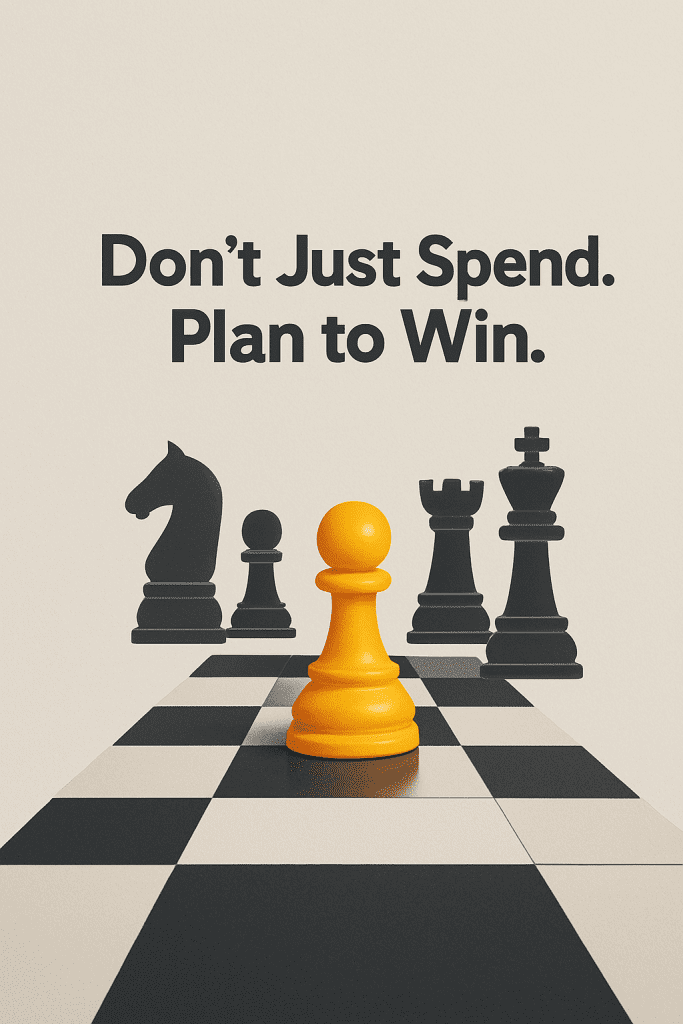
Don’t just spend. Plan to win.
Need a partner who thinks like a start-up but plans like a strategist? Let’s talk : +44 (0)20 7257 2600 or hello@smithfieldagency.co.uk (https://smithfieldagency.com/contact/)